Rick Dalton’s Undiagnosed Bipolar Disorder
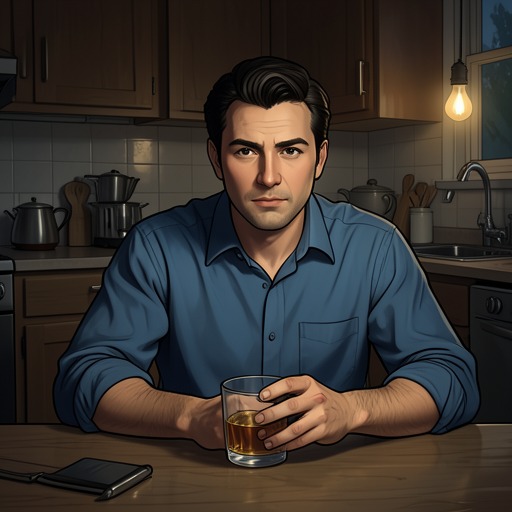
Once Upon a Time in HollywoodRick Dalton’s Undiagnosed Bipolar Disorder shapes his private life beneath the public story of a television actor confronting career decline: since high school, he has endured violent mood swings without knowing their cause, and whiskey becomes his improvised relief from worsening lows. The condition remains unnamed to him for years, leaving distress to be interpreted as personal weakness and career failure until Pete Duel’s death makes the stakes of alcohol and untreated illness newly intimate.
Identity and Background
The narrative identifies Rick’s condition retrospectively: he has experienced violent mood swings since high school, with lows deeper than most people’s and highs that can approach mania. The condition was not commonly known at the time, and Rick does not understand what he is experiencing. The text presents the diagnosis as an explanation for a longstanding pattern, not as knowledge Rick possesses during the episodes themselves.
His downturns become more severe after he completes a four-picture deal with Universal Pictures, particularly following Salty, the Talking Sea Otter. The account links this deepening distress to nights alone at home, where loneliness, boredom, and self-pity combine with self-loathing. Rick experiences these states as a personal crisis rather than as symptoms of an illness he can name.
Symptoms and Alcohol Use
Rick’s drinking offers a concrete measure of how the pattern operates. What might be a couple of whiskey sours for other actors becomes eight for him, enough to black out. After one such night, he wakes in bed without remembering leaving the pool, taking off his clothes, or climbing into bed, and finds that he has vomited over himself. The bedside clock reads 6:52, with Cliff Booth expected in about twenty minutes; Rick has to get himself together before the day begins.
Vomiting leaves him feeling physically better by emptying his stomach, but the immediate relief does not erase the consequences: he feels disgusted with himself and remains ill the next morning. By 7:15, when Cliff arrives, Rick is sweaty, green-complexioned, and still queasy. He expects to get through the next several hours with coffee and cigarettes. The scene joins bodily aftermath to self-reproach, showing how an episode spills into the working day rather than remaining a private nighttime event.
The narration describes whiskey sours as Rick’s only relief-inducing medication during these periods. It distinguishes his drinking from the tolerated excesses of some other actors: Rick’s alcohol use is attributed to a combination of self-loathing, self-pity, and boredom. Because he does not know that he has bipolar disorder, he reads the drinking as evidence of internal weakness, not as an attempt to manage an illness he cannot identify.
Career Distress and Relationships
Professional humiliation and private instability meet in Rick’s response to Marvin Schwarz’s career assessment. As Marvin explains that Italian filmmakers may want Rick as a substitute for Steve McQueen, the blunt comparison brings tears to Rick’s eyes. On the drive home through Los Angeles, the passing hippies provoke his disgust, and he declares himself a has-been. He then describes his career as five years of ascent, ten years of treading water, and a race to the bottom. These moments do not establish that bipolar disorder alone causes his career fears; they show how sharply professional disappointment and emotional distress coincide.
Cliff Booth offers a different perspective on Rick’s proposed move into Italian films. He points out that he has not worked full-time as a stuntman for some time and that travel to Rome does not seem to him like a fate worse than death. His practical comparison does not diagnose Rick, but it exposes how thoroughly Rick experiences a career change as a personal defeat. The contrast is especially pointed because Cliff himself describes their working relationship as driver and gofer as well as a valued routine of rides, auditions, meetings, and house-sitting.
Rick’s later friendship with Pete Duel gives the condition a second, tragic point of reference. While filming Cannon for Cordoba in Mexico, the two actors enjoy tequila, complain about Hollywood, and take pleasure in each other’s company. Neither knows intellectually that both are undiagnosed bipolar, though the narrative says each senses a shared experience. Both use alcohol to self-medicate and interpret their drinking as weakness. Duel’s illness is more severe; at the height of his success on Alias Smith and Jones, he shoots himself in the middle of the night. Rick feels, without being able to explain it publicly, that he understands why Duel died.
Change and Significance
Duel’s death in 1971 becomes a turning point in Rick’s relationship with alcohol. Afterward, Rick does the difficult work of relying less heavily on booze. The change is not presented as immediate abstinence: by 1973, while making The Deadly Trackers in Durango, Mexico, Rick and Richard Harris, both heavy drinkers, keep off alcohol from Monday through Thursday, then drink heavily from Friday night into Sunday afternoon. The routine marks a shift toward limits, while making clear that alcohol remains part of Rick’s life.
The condition also sits beside a gradual recovery of perspective. At a later point, Trudi Frazer reminds Rick that their work is fortunate, and he recognizes how much his acting life has given him: fellow performers, roles, travels, affairs, fan mail, and a house paid for by pretending to be a cowboy. His gratitude does not erase the earlier illness or establish that it has been diagnosed. Instead, it contrasts a decade in which he has struggled to see anything beyond decline with a moment when he can acknowledge the breadth of his good fortune. The narrative’s account of the disorder thus connects an unseen condition to recognizable pressures—loneliness, alcohol, career insecurity, and self-judgment—while preserving the difference between Rick’s experience and the explanation the reader is given.